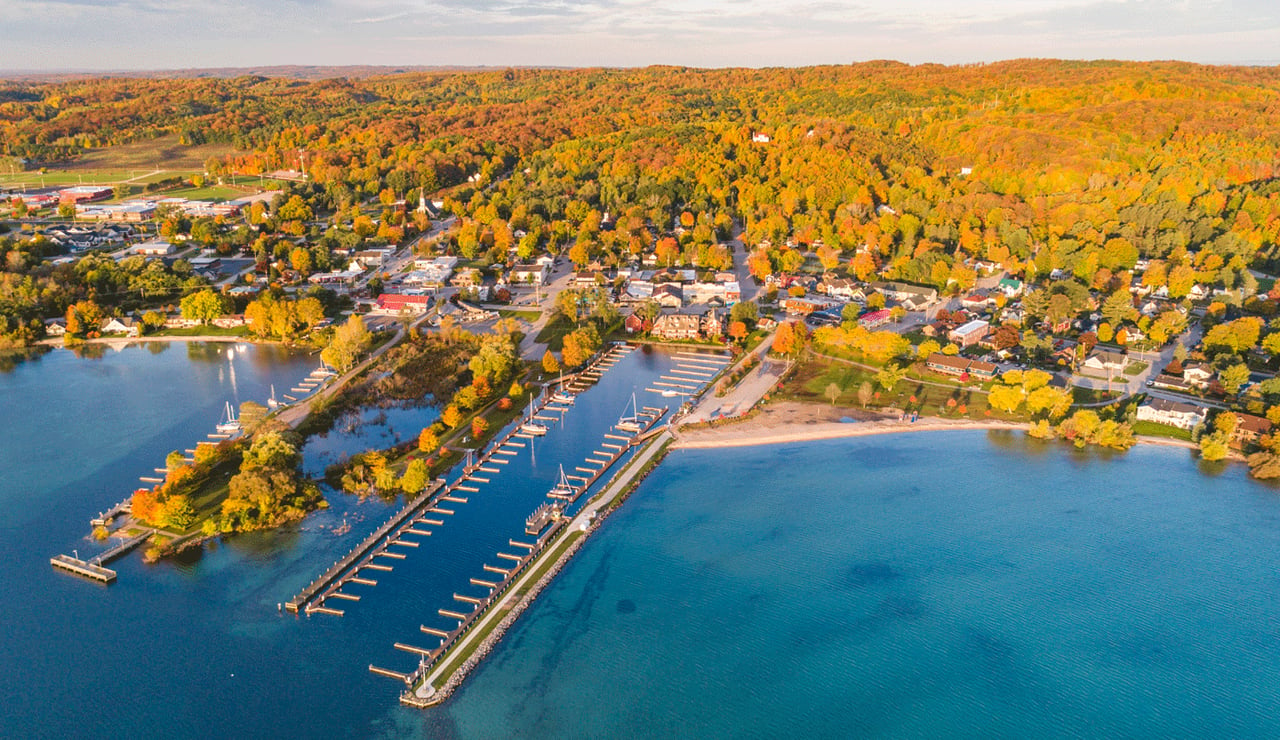
In February, Suttons Bay's harbor master told the Village Council something boaters up and down the peninsula already suspected: the water was low, and it was about to get lower. Edie Aylsworth predicted the marina would see lake levels five to seven inches below the previous year. On February 17, the council approved a contract with Machin Engineering, not to exceed $22,900, to draw up dredge plans, handle permitting, and manage bidding for the work the marina would need to stay usable.
That is a small line item in a village budget. It is also a preview of a question every waterfront buyer on the bay itself, not an inland lake, should be asking before they write an offer: who actually owns the ground under the dock, and what does it take to keep a structure there legally?
Two lakes, two landlords
Leelanau County has waterfront on both sides of a legal line most buyers never hear about. According to a Lake Leelanau riparian-rights guide, frontage on Lake Leelanau, Glen Lake, or one of the county's smaller inland lakes generally sits on bottomland belonging to the riparian property owner. If you own the shore, you typically own the lakebed in front of it, out to a point defined by state riparian law. A seasonal dock that gets pulled every October and reinstalled every May doesn't need a state permit at all, as long as it's private, doesn't interfere with a neighbor's reasonable use, and isn't sitting in a wetland. A permanent structure, a crib dock or a pier that stays in year round, needs a construction permit under Part 301 of Michigan's Natural Resources and Environmental Protection Act. It's a state review, but you're asking permission to build on land you already hold.
Frontage on Suttons Bay itself is different, because Suttons Bay is a bay of Lake Michigan. Grand Traverse Bay's bottomlands are Great Lakes bottomlands, and under Part 325 of the same statute, the State of Michigan owns them outright, held in public trust for boating, fishing, and navigation. Owning the shore does not mean owning the lakebed. A seasonal dock still needs no permit under this rule either. But a permanent structure, a crib, driven pilings, a boathouse over the water, or fill placed below the ordinary high-water mark, needs both a construction permit and a bottomland conveyance from the state: a deed, lease, or agreement authorizing you to occupy land you never actually purchased with the house.
That second requirement is where the timeline stretches. According to EGLE's Great Lakes construction-permit guidance, the construction permit moves through a 30-day completeness review followed by a processing period the state caps at 90 to 150 days. EGLE's bottomland-conveyance guidance says the conveyance is a separate track that runs concurrently and can take a year or more. It includes a 20-day public notice period, a possible hearing, a site inspection, and an appraisal to set whatever one-time or annual fee applies. None of this happens quickly, and none of it happens automatically when a house changes hands. If the upland property sells, the new owner has to apply through the state's MiEnviro portal to have the existing conveyance formally assigned, with proof of ownership attached, before they can legally continue whatever the previous owner was permitted to do.
Why the dock looks the same either way
Here is the part that catches buyers off guard: a permanent dock with a full state conveyance and a permanent dock installed without one look identical from a boat, a drone photo, or a walkthrough. There's no visible marker for "this structure has state paperwork" versus "this structure has been sitting here since 1987 and nobody ever filed anything." The only way to know is to ask for the document and read it.
That's a manageable ask if you know the question exists. Most buyers moving from an inland lake, or moving up from a smaller Michigan market without Great Lakes frontage, don't know it exists, because on an inland lake the question rarely comes up. You already own the bottomland. There's nothing to convey.
On Suttons Bay, older permanent structures are common, and the paperwork trail can be thin. Thin paperwork becomes your problem the moment you want to modify the structure, replace it with something larger, or simply prove to a future buyer that the whole setup is clean.
The village is living this at scale right now
The marina isn't a private dock, but it sits on the same bottomland and answers to the same underlying set of facts, and this year has made that visible in public meetings. Beyond the dredging contract, the council spent the first half of 2026 rewriting the rules that govern the harbor itself. Staff brought a redrafted marina ordinance to the Utility and Marina Committee on June 1, shifting some administrative responsibilities from the harbormaster to applicants and adding conduct standards. The council sent it to a public hearing on June 15, held that hearing on July 20 (it opened and closed within a few minutes), and adopted the result as Marina Ordinance #30 on a unanimous 7-0 vote.
Money moved at the same pace. On June 26, the council approved a $1,325,000 low bid from Eckler Building Solutions for a new public restroom and boater service building, a project staff acknowledged came in well above the original estimate, with additional financing still being arranged. A new fishing pier was completed around the same stretch of meetings. None of this is dramatic by itself. Together it's a working harbor spending real money and real staff time to keep its relationship with the bottomland current: permits, dredge plans, facility upgrades, ordinance language. A private buyer facing a legacy dock on the same bay is dealing with a smaller version of the identical question, just without a village staff and a line item in the Capital Improvements Plan to handle it.
What to ask before you write the offer
If you're comparing waterfront in Suttons Bay to waterfront on one of the county's inland lakes, the price per foot of frontage was never the whole comparison. A few questions belong in your due diligence regardless of what the listing sheet says about the dock:
- Is the dock seasonal or permanent? Seasonal, pulled every fall, needs no state permit on either type of water body. Permanent changes everything downstream.
- If it's permanent and the property fronts Suttons Bay itself, can the seller produce the EGLE bottomland conveyance? Not a contractor's invoice. The actual deed, lease, or agreement.
- If the conveyance exists, has it ever been assigned to a new owner before, and does the seller know the process for doing it again at this closing?
- Does the conveyance carry an annual fee, and is that fee current?
A missing answer to any of these isn't necessarily a reason to walk away from an otherwise good property. It's a reason to build time into your closing timeline and, if needed, a reason to negotiate who handles the assignment application and when.
Inland lake frontage (Lake Leelanau, etc.) | Suttons Bay frontage (Grand Traverse Bay) | |
|---|---|---|
Who owns the bottomland | Generally the riparian property owner | The State of Michigan, held in public trust |
Seasonal dock, pulled each fall | No permit required | No permit required |
Permanent dock or structure | Part 301 construction permit | Part 325 construction permit and a separate bottomland conveyance |
Typical permit timeline | Varies | 90 to 150 days for the permit; the conveyance can run a year or more |
At resale | New owner must apply to assign the conveyance |
A few straight answers
Does this apply to every dock on Suttons Bay, or just the big ones? It applies to any permanent structure below the ordinary high-water mark on Great Lakes bottomland, not just large docks. A modest permanent crib is treated the same as an elaborate one under Part 325. Size affects the permit category and review complexity, not whether a conveyance is required at all.
What if I just want to keep doing what the seller was doing, nothing new? You still need the conveyance assigned to you if one exists, and you'll want to confirm it exists in the first place.
Is this the reason to avoid buying on Suttons Bay itself? Not at all. It's a reason to ask the right question early, the same way you'd ask about a septic system's inspection status before assuming it passed. Bay frontage carries its own advantages, from the marina and downtown walkability to the boating access the village has spent this whole year investing in. The difference is simply that the paperwork lives with the state instead of running with the deed by default.
Waterfront questions like this rarely show up on a spec sheet, and they're exactly the kind of detail worth working through with someone who tracks the local permitting picture, not just the comparable sales. If you're weighing Suttons Bay frontage against an inland lake alternative, or you already own bay frontage and want to know where your dock actually stands, the Schaub Team Premier Realty team can walk the specifics with you. Start with a Get a Free Property Valuation conversation, and bring your questions about the dock along with it.
This article is general information, not legal, tax or financial advice. Consult a qualified professional about your situation.