Thinking about buying land near Suttons Bay for a future custom home? A beautiful view and a great location are only part of the story. Before you fall in love with a parcel, you need to know whether you can actually build the home you have in mind. This guide walks you through the local factors that matter most, from zoning and access to septic, well, and site conditions, so you can move forward with more clarity and confidence. Let’s dive in.
Start With Jurisdiction and Zoning
One of the first things to confirm is whether the property is in the Village of Suttons Bay or Suttons Bay Township. That distinction matters because the village has its own utilities department and separate planning and zoning application forms, while the township follows its own zoning ordinance and map.
You should not assume nearby parcels follow the same rules. A lot inside the village may have a very different approval path than one just outside it in the township. Checking jurisdiction early can save you time, money, and frustration.
Township lot standards matter early
In Suttons Bay Township, zoning districts include Agricultural, Residential, Commercial, Industrial, and Waste Management. The township ordinance sets base lot standards, including a minimum lot area of 2 acres in Agricultural districts and 1 acre in Residential, Commercial, and Industrial districts.
Minimum lot width also matters. The ordinance lists 200 feet in Agricultural districts and 150 feet in Residential, Commercial, and Industrial districts. Those baseline standards can shape whether a parcel fits your future house plan before you even start sketching designs.
Waterfront and shore-adjacent parcels need extra review
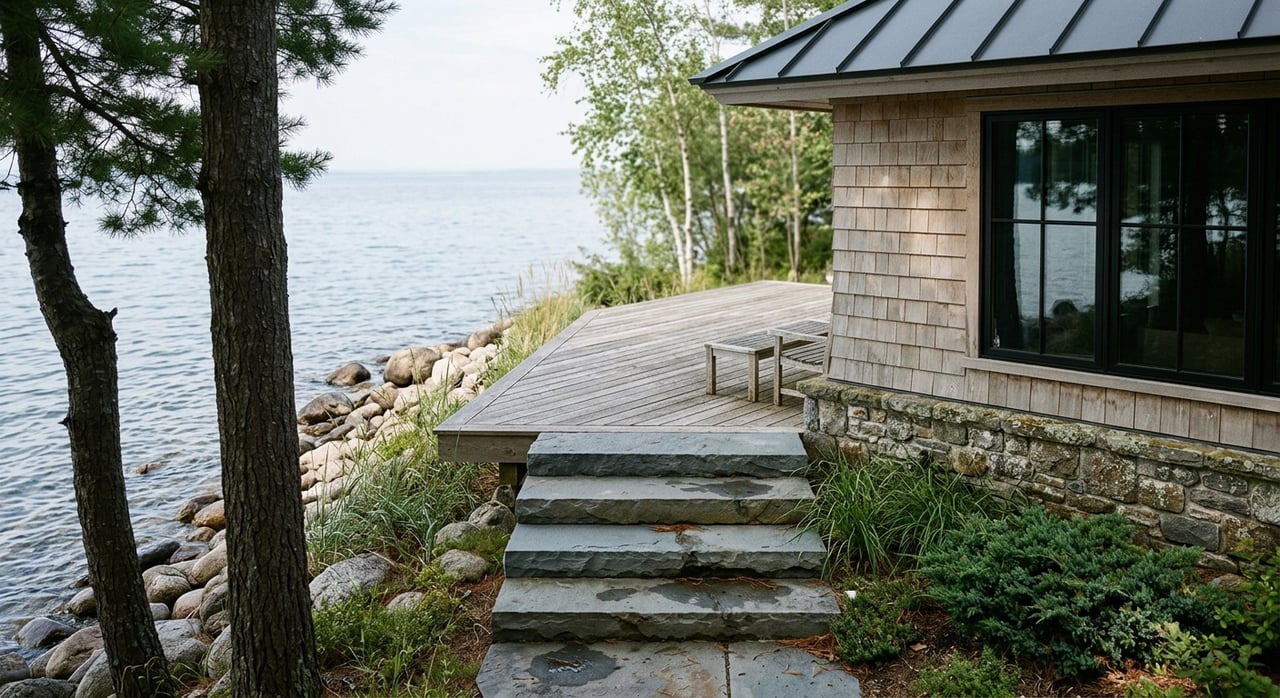
If you are considering a waterfront parcel or one near the shoreline, take a closer look at setback rules. In Suttons Bay Township, lots created after September 14, 1994 must generally meet a 50-foot shoreline setback.
Older lots of record may have averaging options, but minimum setback limits still apply. In some cases, reduced front or rear setbacks for wells or septic systems may be considered only when health authorities certify there is no reasonable alternative and the encroachment is minimal.
Buildability Starts With Access
A scenic parcel is not necessarily a buildable parcel. Legal access is one of the most important issues to verify before writing an offer.
In Suttons Bay Township, no dwelling unit may be built unless the lot abuts a public street or has a permanent, unobstructed access easement of record to a public street. That easement generally must be at least 30 feet wide.
Private roads need careful review
If the land is served by a private road, you will want to dig deeper. Township rules require private-road designs to address width, drainage, emergency vehicle access, and construction standards.
The Leelanau County Road Commission also notes that driveway permits are required. If a driveway connects to an existing private road, an application can be issued once the road is confirmed to be private and not maintained by the commission.
Utilities Can Change the Whole Plan
Utility availability is another major fork in the road. Some parcels may have access to public water and sewer, while others will depend on private systems.
Inside the Village of Suttons Bay, the village utilities department operates the water and sewer system. For a new home, buyers are advised to contact the department to learn how service will be provided.
Outside the village, private systems may be required
If the parcel is outside municipal service areas, you may need a private well and on-site septic system. In that case, the vacant-land evaluation process through the Benzie-Leelanau District Health Department becomes a key first step.
This is not a box to check at the end. It is one of the earliest signs of whether a parcel can practically support the home you want to build.
Septic and Well Feasibility Can Make or Break a Deal
For vacant land that will need an on-site septic system, the health department evaluates a wide range of site conditions. That includes soil type and permeability, seasonal high-water table depth, slope, separation distances, available suitable area, hydrogeology, runoff patterns, proposed land use, easements, buried utilities, and neighboring development.
In plain terms, a parcel can look ideal from the road and still present expensive or time-consuming challenges below the surface. That is why septic and well feasibility deserve attention before your plans move too far ahead.
Existing systems should be reviewed early
If the parcel already has a well or septic system, you should review available records as early as possible. The health department’s records portal can help locate past well and septic records.
For vacant land, a transfer evaluation is not required unless a well or septic system is actually on the parcel. Still, existing records can offer useful clues about what is already there and what may need further review.
Your future bedroom count matters
Septic design is tied to the home you plan to build. According to the health department, residential septic tank capacity is based on bedroom count and whether a garbage grinder is installed, while drainfield size depends on bedroom count and on-site soil characteristics.
That means a parcel that works for a smaller home may not automatically work for a larger one later. If you expect to expand, add bedrooms, or change the use over time, it is smart to think beyond your first draft plans.
Site Conditions Matter More Than Many Buyers Expect
In Leelanau County, some of the biggest surprises for land buyers involve the land itself. Slope, drainage, wetlands, and erosion control can all affect the cost, timeline, and practical design of a future custom home.
These issues are especially important because they may not be obvious during a casual showing. A wooded setting or elevated view can be appealing, but site conditions still need to support safe and compliant construction.
Erosion, wetlands, and slopes may trigger permits
The Leelanau Conservation District says a Soil Erosion and Sedimentation Control permit is required for commercial projects, earthwork within 500 feet of a lake or stream, earthwork within 100 feet of a regulated wetland, driveways with a slope of 10 percent or greater, and any project disturbing one or more acres of soil.
EGLE permits are also required for work below the ordinary high-water mark, in streams or wetlands, or in a Critical Dune Area. Depending on the parcel, these requirements can influence both your construction plan and your timeline.
Site-plan review may require detailed information
For projects that require site-plan review, township standards can call for topography information, generalized soil data, erosion-control measures, and evidence that the project will not create additional stormwater runoff.
The township may also forward plans to agencies such as the fire and rescue service, county road commission, MDOT, health department, drain commissioner, sheriff, and others as applicable. No construction may begin until all required permits and approvals are presented to the zoning administrator.
Match the Lot to Your Home Plan
One of the most common mistakes land buyers make is choosing the parcel first and testing the home plan later. In reality, the better approach is to see whether the lot supports the house you want, not just whether the lot looks appealing on its own.
In Suttons Bay Township’s Residential District, one-family detached or semi-detached dwellings are permitted by right. But that does not automatically mean every lot can handle every design.
Think beyond the house footprint
Your future plan needs room for more than the main structure. You may also need to fit a garage, driveway, well, septic system, septic reserve area, and possible future additions while still meeting setbacks and other requirements.
If the layout is too tight, you could face redesigns, added cost, or the need for a variance or other approval. A parcel that looks large enough at first glance may still have practical limits once the full plan is mapped out.
A Smart Order of Operations
If you are buying land near Suttons Bay for a custom build, a clear sequence can help you avoid costly surprises. Local review processes point to a practical order that makes due diligence more effective.
Here is a useful path to follow:
- Confirm whether the parcel is in the Village of Suttons Bay or Suttons Bay Township
- Verify zoning and baseline lot standards
- Confirm legal access and review any easements or private-road issues
- Determine whether public water and sewer or private well and septic will be needed
- Order or review records and vacant-land evaluations where applicable
- Check slope, drainage, shoreline, wetland, and erosion-control constraints
- Have a builder or designer test the lot against setbacks, footprint, and future expansion plans
Questions to Answer Before You Write an Offer
Before you move forward, it helps to ask a few practical questions. These are often the issues that separate a promising parcel from a frustrating one.
Is it a legal lot of record and buildable as-is?
Some lesser-sized lots of legal record may predate the current ordinance. Even so, new construction still has to meet applicable placement, access, and use rules.
Could the parcel need extra approvals?
Depending on the site, you may need a variance, special land use permit, site-plan review, or agency sign-off. Shoreline rules, access limitations, septic constraints, and more complex land uses can all create additional review steps.
What usually surprises buyers in this area?
The biggest surprises are often not about architecture or finishes. They are usually access, septic, slope, drainage, wetlands, or the fact that a parcel falls under a different jurisdiction than expected.
Buying land for a future custom home near Suttons Bay can be a smart and exciting move, especially when your long-term vision matches the realities of the site. The key is doing the right local homework before you commit. If you want experienced guidance on land, custom-build opportunities, and the details that shape buildability in Leelanau County, connect with Schaub Team Premier Realty.
FAQs
What should you check first when buying land near Suttons Bay?
- Start by confirming whether the parcel is in the Village of Suttons Bay or Suttons Bay Township, then verify zoning, lot standards, and access.
How do septic rules affect vacant land near Suttons Bay?
- For parcels that need on-site septic, the Benzie-Leelanau District Health Department evaluates soil, slope, water table depth, separation distances, runoff, and other factors that affect whether the land can support a system.
Do all lots near Suttons Bay have public water and sewer?
- No. Parcels inside the village may have access to village utilities, while parcels outside municipal service areas may require a private well and septic system.
Why does legal access matter for land in Suttons Bay Township?
- Township rules say a dwelling cannot be built unless the lot abuts a public street or has a permanent, unobstructed access easement of record to a public street, generally at least 30 feet wide.
What site issues can affect a future custom home near Suttons Bay?
- Slope, drainage, wetlands, shoreline setbacks, erosion-control requirements, and stormwater considerations can all affect design, permits, cost, and timeline.
Can a parcel support a larger home later if it works now?
- Not always. Septic capacity and drainfield size are tied to bedroom count and site conditions, so a parcel that supports one plan may need further review for future expansion.